Get in touch
Cambridge Roof Exchange Ltd
Unit 2 Barton Court, Comberton, Cambridge CB23 7BU. Survey-led industrial roof refurbishment across the UK.


Built before 2000? Learn how asbestos cement roofing affects factories and warehouses, and what your options are for refurbishment, overcladding or replacement.
Ben Thomas · Marketing & Sales Co‑ordinator · Cambridge Roof Exchange
8 min read
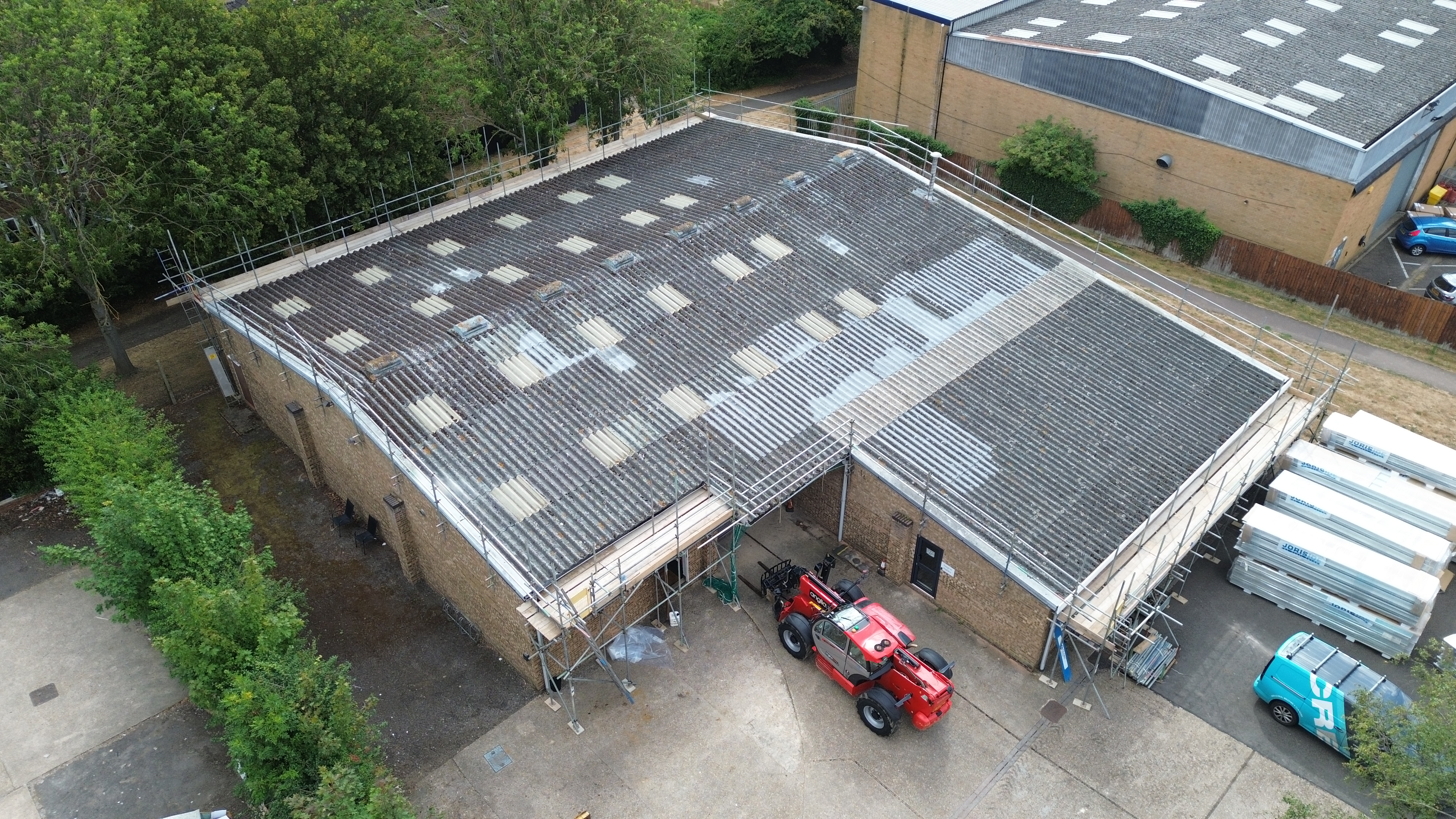
The age of an industrial building can reveal a great deal about its roof, and for any warehouse, factory or industrial unit constructed in the twentieth century, one question deserves to be asked before any maintenance or refurbishment is planned: could the roof contain asbestos?
Across the UK, thousands of industrial buildings remain in daily use decades after they were first constructed, and from ground level many of their roofs look entirely ordinary. According to the Health and Safety Executive (HSE), asbestos should be assumed to be present in any building constructed or refurbished before the year 2000 unless there is evidence to show otherwise [1], because asbestos-containing materials were used widely in UK construction until they were banned in 1999 [2]. For Britain's ageing industrial building stock, this makes asbestos management a live property issue that affects budgets, planning and safety today, rather than a legacy problem from the past.
The scale of the issue becomes clearer when you look at the government's own data. The Department for Energy Security and Net Zero's 2025 Non-Domestic National Energy Efficiency Data Framework (ND-NEED) identified approximately 1.748 million non-domestic buildings across England and Wales, and among those with a recorded construction date, 63% were built before 1970 [3]. The same dataset counts around 240,000 factory buildings, while warehouses account for roughly 222 million m² of floor space, which is 36% of the measured non-domestic floor area [3].
A substantial proportion of the industrial property in England and Wales therefore dates from a time when building materials, insulation standards and roofing systems were very different from those specified today, and many of these buildings are still doing exactly the job they were built to do.
Asbestos became popular in construction because it offered resistance to heat, fire and corrosion and could be incorporated into a wide range of building products, one of which was asbestos cement roofing. The HSE specifically lists asbestos cement sheets among the products in which asbestos may still be found in older buildings, including roofing and wall cladding [4].
The presence of asbestos does not automatically mean that a roof has to be removed immediately, since the risk increases when the material becomes damaged or is disturbed and fibres are released [4]. An older asbestos cement roof that has been left undisturbed is a very different proposition from one that is deteriorating, leaking or about to undergo substantial refurbishment, and this distinction shapes almost every decision that follows.
Before anyone drills, cuts, removes sheets, installs new penetrations or carries out any other work that could disturb the building fabric, the material needs to be properly understood. HSE guidance states that installation or refurbishment work which disturbs the fabric of a building where asbestos could be hidden requires a more intrusive survey before the work begins [1].
Ageing industrial roofs rarely suffer from a single problem, and it is common for a building to have a tired roof covering alongside deteriorated rooflights, ageing gutters, poor insulation, a history of patch repairs and areas of water ingress. That combination leaves property owners with a difficult question, which is whether to keep repairing the roof, refurbish it, overclad it or replace the existing system entirely.
No single answer applies to every building, because the right approach depends on the condition of the existing sheets, the underlying structure, the roof geometry, the extent of any water ingress, the future use of the property, insulation requirements and any plans to install equipment such as solar PV. This is the main reason a thorough survey of the existing roof should come before any specification is written.
It is easy to assume that an old roof automatically calls for complete replacement, yet in some circumstances refurbishment or a carefully designed overcladding system can offer a better route, while in others removal and replacement will be the more appropriate long-term solution. The decision should be driven by the building itself, rather than by choosing a system first and then trying to make the building fit around it.
This thinking is consistent with wider developments in the construction industry, and the RICS whole life carbon standard notes that reusing and refurbishing existing structures is often the most efficient approach, because it minimises the need for new materials and reduces demolition waste [5]. For an industrial property, a roof refurbishment can therefore become a chance to address several issues at once, instead of dealing with each one separately as it becomes urgent.
When major roofing works are unavoidable, simply recreating the roof that was installed decades ago can mean missing a valuable opportunity. Depending on the building and the specification, a refurbishment project can include:
Government energy data shows why the performance of large buildings deserves attention. In the 2025 ND-NEED analysis, buildings above 1,000 m² make up around 7% of non-domestic buildings yet are responsible for 60% of electricity consumption and 70% of gas consumption [3], which means that on a large industrial property a roof project can form part of a wider strategy covering energy performance, building longevity and future investment, rather than being purely a roofing decision.
For factories, distribution centres and warehouses, closing the building for several weeks is often unrealistic, so it is reassuring that roof refurbishment projects can frequently be planned in phases around operational requirements, although the exact approach will depend on the building, the roof construction and the work being carried out. Access routes, exclusion zones, internal protection, sequencing, weather conditions, asbestos controls and the activities taking place below all need to be built into the project plan, and for a production facility or busy warehouse the way the work is carried out can matter just as much as the roofing system that is finally installed.
For anyone responsible for a factory, warehouse or commercial building constructed before 2000, the first step does not have to be commissioning a replacement roof, and is instead to understand what is currently in place. Existing asbestos information, building records and asbestos registers should be checked first [1], after which the roof can be assessed for visible deterioration, drainage problems, rooflight condition and other defects before any intrusive investigation or refurbishment work is planned.
A drone roof survey can be especially useful for gaining an initial overview of large or difficult-to-access roof areas without putting people onto fragile roof surfaces, although it should never be treated as a substitute for an appropriate asbestos survey where asbestos identification is required.
At Cambridge Roof Exchange, we work with industrial and commercial property owners to assess existing roofing systems and to develop refurbishment solutions shaped around the condition, operation and future requirements of each building. Our services range from asbestos strip-and-re-sheet projects and overcladding through to insulation upgrades, rooflights, gutter refurbishment and PV-ready roofing systems, and in every case our aim is the same, which is to understand the existing building first and then specify the right solution for its future.
To discuss the roof on your own warehouse or factory, get in touch with our team to arrange a survey.
Does every industrial building built before 2000 have an asbestos roof?
Not necessarily, but the HSE advises that asbestos should be assumed to be present in buildings constructed or refurbished before 2000 unless there is evidence showing otherwise, so checking asbestos registers and commissioning the appropriate survey is the sensible starting point [1].
Does an asbestos cement roof have to be removed immediately?
No, because the risk rises when the material is damaged or disturbed, and an undisturbed roof in good condition can often be managed in place, although deterioration, leaks or planned refurbishment work will change the picture considerably [4].
Is overcladding an alternative to replacing an asbestos roof?
In some cases it is, but whether overcladding is suitable depends on the condition of the existing sheets and the supporting structure, which is why a survey should come before any decision about the system.
Can a drone survey replace an asbestos survey?
No, a drone survey is a valuable way to inspect large or fragile roofs safely, but it does not replace an asbestos survey where asbestos identification is required.
Get in touch
Send us the site details, drawings or photos and we'll advise whether the right route is repair, overclad, replacement or asbestos removal. No obligation.