Get in touch
Cambridge Roof Exchange Ltd
Unit 2 Barton Court, Comberton, Cambridge CB23 7BU. Survey-led industrial roof refurbishment across the UK.


Rising energy costs and rooftop solar are turning the industrial roof into a valuable energy asset. Here's why roof condition, insulation and solar should be planned together.
Ben Thomas · Marketing & Sales Co‑ordinator · Cambridge Roof Exchange
6 min read
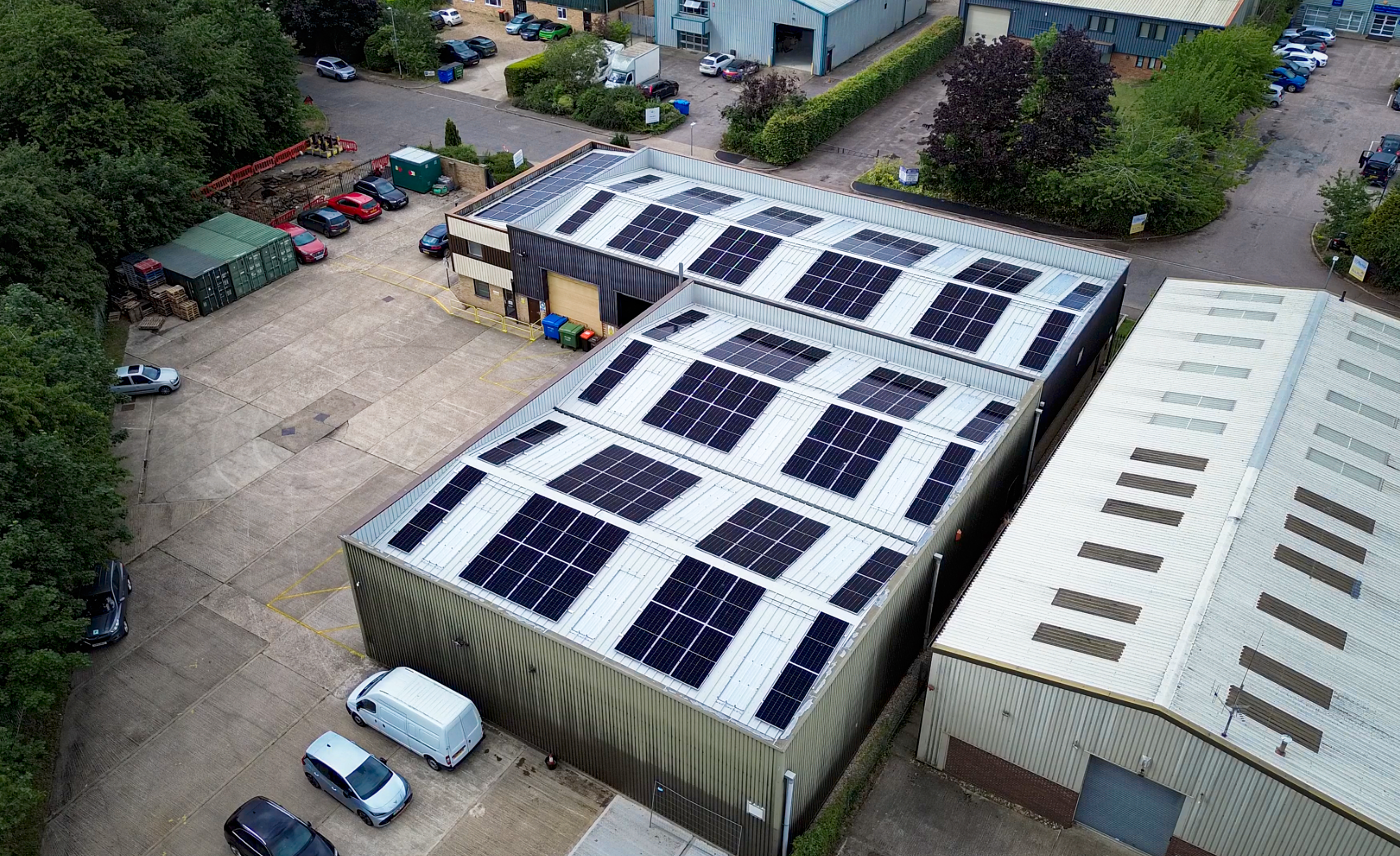
For decades, the roof of an industrial building has had one job: keep the weather out. If it did that, nobody gave it much thought until the day it stopped.
That is starting to change. Rising energy costs, tighter building standards and the rapid growth of rooftop solar mean the thousands of square metres above warehouses, factories and distribution centres are becoming far more valuable than most owners realise. A roof now influences energy consumption, EPC performance, solar generation, running costs and the long-term value of the building itself.
The scale is hard to overstate. The UK Government's Solar Roadmap points to research suggesting that the largest 20% of UK warehouses alone could offer around 75 million square metres of roof space worth considering for solar. That is enough to support roughly 15GW of capacity.
More recent analysis from the UK Warehousing Association goes further, putting the potential at around 17.3GW across the largest warehouse rooftops. When its researchers looked at more than 300 verified warehouse roofs, only about 5% appeared to have solar installed. So there is a huge amount of unused space sitting above UK businesses right now.
But covering every available roof in panels isn't the answer. What is underneath them matters first.
Picture a large PV array going onto a roof that needs major refurbishment five years later. The panels have to come off, the work gets done underneath, and then the whole system is reinstated. That is extra cost, extra complexity and extra disruption, all of which could have been avoided by looking at the roof and the energy strategy together.
That is why solar projects increasingly begin with a simple question: is this roof actually ready for what we want to put on it?
Answering that means looking at a range of things: how much life the roof has left, its structural capacity, the existing insulation, the condition of the rooflights, the waterproofing, the gutters and drainage, any corrosion or deterioration, access and safety, future maintenance needs, and the layout and lifespan of the proposed PV system.
Where major works are already on the horizon, there is a smart opportunity here. Rather than running refurbishment, thermal upgrades and solar as three separate projects, an owner can improve the whole roof asset in one coordinated move.
Generating electricity is only half of the picture. Reducing how much energy the building needs in the first place can be just as valuable.
Government guidance shows how seriously thermal performance is now taken. The 2026 edition of Approved Document L, which covers buildings other than dwellings, gives an improved U-value of 0.18 W/(m²·K) for roofs in existing buildings, with a threshold figure of 0.35 W/(m²·K), depending on the circumstances and requirements of the works. The lower the U-value, the better the roof resists heat transfer.
On a small building, that difference might not seem dramatic. Scale it up, though, and it looks very different.
Take a hypothetical 10,000m² industrial roof with a 15°C temperature difference between inside and outside. At a U-value of 0.35, the theoretical rate of heat transfer through the roof is 52.5kW. Bring the U-value down to 0.18 and that falls to 27kW, a reduction of about 49% under those conditions.
To be clear, that isn't an energy-bill prediction. Real savings depend on heating systems, occupancy, air leakage, operating hours, the weather and plenty more. But it shows why insulation matters so much once you multiply it across a large building.
According to the Department for Energy Security and Net Zero, UK non-domestic users paid a provisional average of around 24.3p per kWh for electricity and 5.3p per kWh for gas in 2025, across all consumption bands and including the Climate Change Levy. Individual contracts vary a lot, but those numbers explain why wasted energy hurts.
A building that needs less energy to hold its internal environment is simply less exposed to those prices. And that sets up a neat combination. Improve the thermal performance and you reduce demand. Add well-designed rooftop solar and you can generate a share of the electricity that remains. The roof starts working on both sides of the equation.
The Solar Roadmap cites UK Warehousing Association estimates that rooftop solar could cut annual electricity costs by 40 to 80% in suitable industrial and warehouse settings, with potential savings of around £3 billion a year across the sector.
Those aren't guaranteed figures for any single building. Consumption profile, system size, location, grid connection, export arrangements, roof orientation and financing all shape the business case. But they point to a much bigger shift in industrial property.
Historically, a roof was almost purely a liability on the balance sheet. It deteriorated, it needed inspecting, it leaked, and eventually it needed replacing. Today, a properly planned roof can help lower energy demand, support renewable generation and prepare a building for future environmental requirements. That changes the whole conversation.
Solar panels typically have operational lives measured in decades. Fitting a long-term solar installation onto a roof that is nearing the end of its serviceable life creates an obvious mismatch.
So the best time to think about PV isn't necessarily after a roof project has finished. It may be before the roof specification has even been settled. A coordinated approach lets structural requirements, insulation, rooflights, waterproofing, penetrations, access routes and the solar layout all be considered together. It also avoids the unpleasant surprise of discovering, halfway through a PV project, that the roof underneath needs major remedial work.
An ageing roof doesn't automatically mean stripping everything back and starting from scratch. Depending on its construction and condition, an existing roof may be suitable for an overclad system, where a new engineered system is installed over the existing one rather than replacing it entirely.
Where it is appropriate, overcladding gives you the chance to improve thermal performance, renew the external weathering layer and add new rooflights and drainage improvements, while cutting some of the disruption of a full strip and replacement. For a working factory, warehouse or distribution building, that disruption can matter as much as the construction cost. Halting production or closing off sections of a building has a real financial impact, so designing the works around a live operation becomes part of the return on investment.
The way we think about industrial buildings is shifting. We now expect one building to use less energy, generate its own electricity, accommodate new technology and stay in service for longer. The roof sits at the centre of nearly all of those goals.
The national picture shows how much potential is still untapped: 75 million m² of space across just the largest fifth of UK warehouses, around 15GW of estimated solar potential, sector-wide electricity savings measured in billions of pounds, and building standards that put ever more weight on energy performance.
So the most important question for property owners may no longer be "how much will it cost to repair the roof?" It may be "what could this roof do for the building over the next 20 to 30 years?"
That is a far more valuable conversation to have.
Get in touch
Send us the site details, drawings or photos and we'll advise whether the right route is repair, overclad, replacement or asbestos removal. No obligation.