Get in touch
Cambridge Roof Exchange Ltd
Unit 2 Barton Court, Comberton, Cambridge CB23 7BU. Survey-led industrial roof refurbishment across the UK.


Autumn exposes heat loss, condensation and daylight gaps in industrial buildings. Learn what the season reveals about your roof’s performance.
Ben Thomas · Marketing & Sales Co‑ordinator · Cambridge Roof Exchange
14 min read
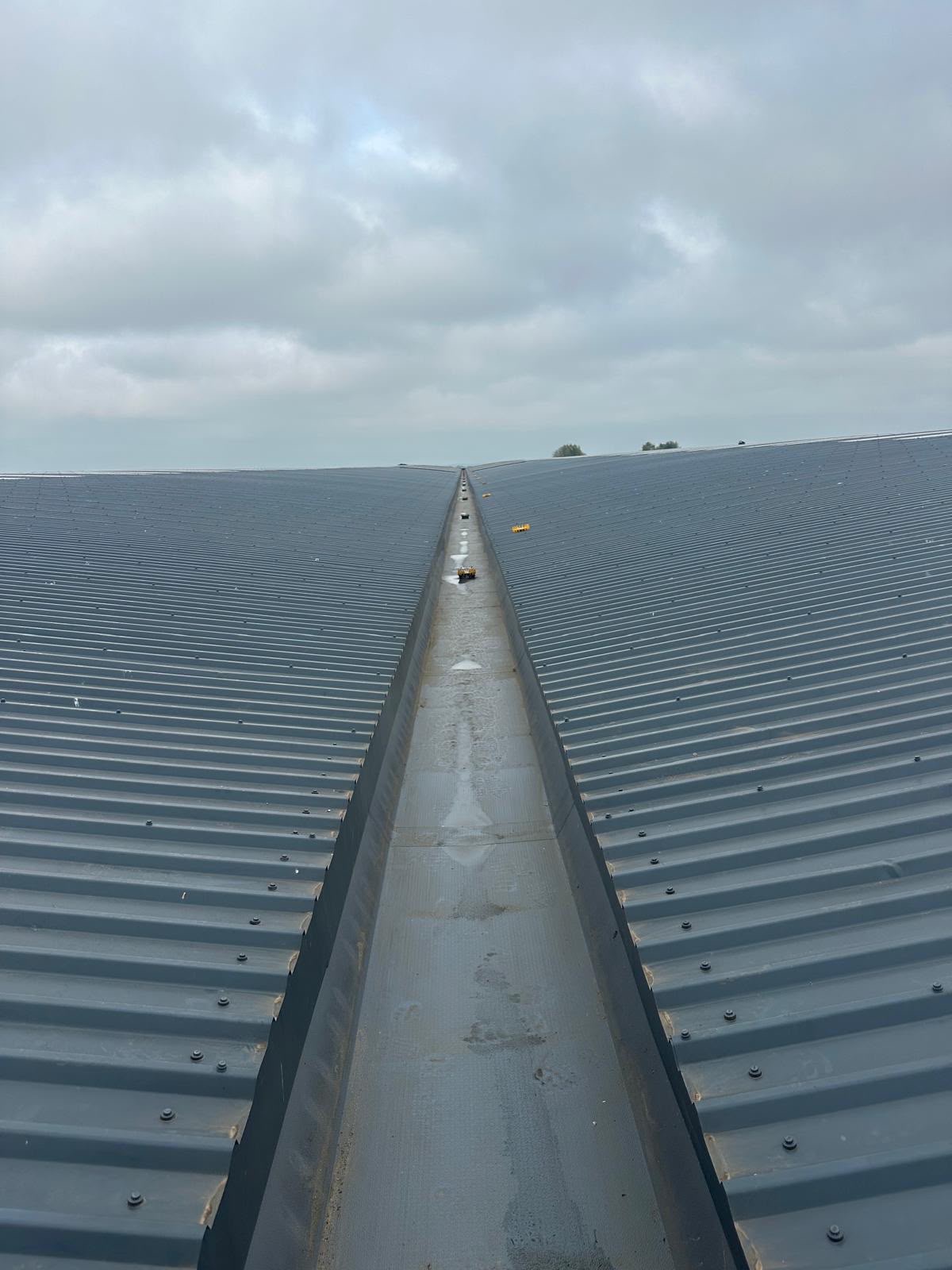
There is something unusual about autumn in Britain. Outside, the landscape is going through one of its most dramatic transformations: trees are withdrawing nutrients from their leaves, temperatures are falling and the natural world is preparing for a period of reduced activity. Inside Britain’s industrial buildings, almost the opposite is happening. Heating systems run more often, artificial lighting is needed earlier in the afternoon, and the gap between internal and external temperatures widens, while production lines, warehouses and distribution centres carry on at their usual pace.
For nature, autumn is a gradual reduction in energy use. For many commercial and industrial buildings, it marks the start of a significant increase. Somewhere between those two opposing processes sits a useful question: what can the changing seasons tell us about the buildings we rely on every day?
Most people associate autumn maintenance with clearing gutters and preparing for bad weather. But the season also offers a chance to understand how a building performs as a complete system: not just whether it is watertight, but how well it retains heat, manages moisture, uses daylight and responds to changing conditions. For industrial property owners, facilities managers and businesses occupying large commercial premises, those questions matter more every year.
An industrial warehouse can look identical in July and October. The steel frame is unchanged, the walls occupy the same footprint and the roof covers exactly the same area. Yet from an environmental point of view, it can behave like a completely different building.
Take a typical facility held at an internal temperature of 18°C. On a mild summer day with an outside temperature of 18°C, there is little temperature difference driving heat through the building envelope. On an autumn morning when the outside temperature has dropped to 6°C, that difference has grown to 12°C, and for any given building element the rate of heat transfer rises roughly in proportion.
The relationship can be expressed simply: heat loss (W) = U-value × area × temperature difference. The U-value describes how readily heat passes through a building element, and the lower the figure, the better the insulation.
Imagine a warehouse with a 5,000 m² roof and a U-value of 0.70 W/m²K. A 12°C temperature difference produces around 42,000 watts of heat transfer through the roof. Upgrade that roof to a U-value of 0.18 W/m²K and, under identical conditions, the figure falls to around 10,800 watts, a reduction of roughly 74% in conductive heat loss through the roof. That 0.18 figure isn’t arbitrary: it is the limiting U-value for flat roofs on buildings other than dwellings set out in Approved Document L, Volume 2, and SCI’s Steel Construction guidance explains how it applies to single-storey industrial buildings. steelconstruction
These figures are illustrative. They exclude air leakage, thermal bridging and temperature variation, and they do not represent a 74% cut in the building’s total heating bill. But they demonstrate something important: a building that appears perfectly functional can become considerably more expensive to run as the seasons change. Autumn doesn’t create the inefficiency. It simply makes the consequences more visible.
You can see what this looks like in practice on our commercial cladding and asbestos project in Haverhill, where a new 230mm built-up roof system was installed over the existing asbestos cement roof to deliver a watertight, thermally efficient roof that meets modern standards, and on our commercial overclad in Waterbeach, delivered with improved thermal performance as a core objective. cambridgeroofexchange
In summer, some weaknesses stay fairly well hidden. A poorly insulated roof may contribute to overheating, but its effect is hard to separate from solar gain, ventilation, machinery and other internal heat sources. In winter, extreme temperatures tend to dominate the conversation. Autumn sits between the two, and as heating demand starts to climb, the relationship between a building’s envelope and its energy use becomes much easier to read.
That makes it the ideal time for what could be called a seasonal energy audit. Rather than looking only at annual bills, facilities managers can watch how performance changes as conditions shift. Does heating demand rise disproportionately once outside temperatures fall below a certain level? Are some areas of the warehouse consistently colder than others? Does the building hold its warmth overnight, or does the internal temperature drop quickly once the heating switches off? Is there a noticeable difference between recently refurbished sections and older parts of the building?
A rise in energy use does not automatically point to a roofing problem. Heating controls, ventilation, operating schedules and equipment efficiency all play a part. But the roof makes up a large share of the external envelope on most industrial buildings, so its thermal performance can make a meaningful contribution to the overall picture, and autumn is a good moment to start asking questions that might otherwise be overlooked.
When we think about weather affecting buildings, we usually picture external conditions: rain on roof sheets, wind across exposed surfaces, cold air circulating around the structure. But every occupied industrial building also has its own internal climate, and in autumn the interaction between the two becomes particularly interesting.
Warm air can hold more water vapour than cold air. As air cools, it can reach a point at which it becomes saturated, and condensation forms on any surface colder than that point. This is the dew point. In an industrial building, moisture comes from many sources, including manufacturing processes, washing operations, people, vehicles and outside air moving into the premises. When warm, moisture-laden internal air meets colder parts of the building envelope, condensation can form if the surface temperature is below the dew point. In some cases it can also develop within the roof construction itself.
This matters because the resulting moisture may have nothing to do with a leak. A building can suffer moisture-related problems even when its external roof covering is completely intact, and a water stain beneath a roof does not, on its own, tell you where the water came from. Finding the cause may mean assessing ventilation, insulation continuity, vapour control, thermal bridging and the way the building is used. The British Standard for this, BS 5250, Management of moisture in buildings, treats moisture as a major cause of building failure and takes a whole-building approach to managing it. bsigroup
As the temperature gap between inside and outside widens through autumn, the conditions that encourage condensation tend to occur more often. Sometimes the most useful question is not whether water is getting into a building, but why water is forming inside it. The answer can completely change the right solution.
One of autumn’s most noticeable features is the steady loss of daylight. In Cambridge, the longest day brings around 16 hours 46 minutes of daylight, while the winter solstice brings only around 7 hours 42 minutes, and much of that loss happens between the autumn equinox and late December (you can track it on timeanddate’s Cambridge sun calendar). sunrisesunset
Consider a distribution warehouse operating from 7am to 6pm. In summer, natural light is available for most of that working day. By late autumn, a much bigger share of the shift takes place in darkness or low light. The building hasn’t changed and neither have the operating hours, but the balance between natural and artificial lighting has shifted significantly.
This is where rooflights come into the discussion. In suitable buildings, well-designed rooflights can bring daylight deep into internal spaces that would otherwise depend heavily on artificial lighting, reaching areas well away from the perimeter walls in a way that windows cannot. How well they work depends on roof geometry, orientation, internal layout, glazing specification and the position of racking and equipment. The Rooflight Association, formerly NARM, publishes free technical guidance on rooflight design, specification and installation for anyone wanting to go further. roofingtoday
Autumn is also a reminder that daylighting and thermal efficiency can’t be considered separately. A rooflight that brings in natural light also affects heat transfer and solar gain, so simply adding more glazing can create unintended consequences. The goal is not to maximise glazing but to strike the right balance between daylight, insulation, comfort and energy performance. On our SRS Aromatics project in Bury St Edmunds, the new 130mm composite roof was installed with replacement rooflights and upgraded roof details, bringing together improvements to natural daylight and rainwater management. Our Sealed Air warehouse refurbishment in St Neots, a 5,000 m² facility (the same size as the example above), also included industrial rooflights as part of the wider scheme. cambridgeroofexchangecambridgeroofexchange
For businesses considering roof refurbishment, this is an opportunity to think beyond like-for-like replacement and design a roof that actively supports the way the building operates.
Every autumn, deciduous trees go through a remarkable process. As the season progresses, trees slow their production of chlorophyll, and the chlorophyll left in the leaves is broken down and stored for the tree to use later, as the Woodland Trust explains. By the time the leaves fall, the tree has already preserved its most valuable resources. woodlandtrust
Industrial buildings are not living organisms, but the parallel is useful. Both do better when they anticipate changing conditions rather than reacting after resources have been lost. In property management, that principle is usually called preventative maintenance, but the most effective approach goes further than scheduling inspections at fixed intervals. It means understanding the condition of individual components, the consequences of failure and the likely timing of future work.
Two industrial roofs of the same age can need very different strategies. One may have benefited from regular inspections, good drainage management and timely repairs, while the other has seen years of deferred maintenance. Their chronological ages are identical, but their remaining useful lives may not be.
This distinction becomes especially important across a portfolio. Rather than treating each roof as an isolated maintenance cost, owners can view roof condition as part of a wider asset strategy that takes in inspection records, repair history, operational disruption, warranty conditions and long-term refurbishment needs. Energy performance is increasingly part of that picture too: under the minimum energy efficiency standard for non-domestic rented property, landlords in England and Wales cannot grant a tenancy where the property’s EPC rating is F or G, unless a valid exemption applies. Our Aldi and Lok’n Store project in Staines-upon-Thames is a good example of refurbishment planned around an asset’s next chapter, with the building renovated ahead of a new lease. businesscompanioncambridgeroofexchange
Autumn is a natural time to review these factors before the colder months, not because every roof needs immediate work, but because understanding an asset’s condition lets future spending be planned far more intelligently.
A successful industrial roof rarely attracts attention. When it performs as intended, staff arrive, deliveries happen, production continues and customers receive their orders, and nobody gives a thought to the structure overhead. Some of the most valuable things a building does are the least visible. A roof that keeps internal temperatures stable, drains effectively and protects business operations is contributing every day, yet that contribution is rarely described in the same terms as production efficiency, logistics performance or equipment reliability. Perhaps it should be.
In a food manufacturing facility, temperature stability, hygiene and continuity of operations can all be essential. In a logistics warehouse, an interruption can ripple through an entire supply chain. For emergency services, the stakes are higher still, which is why projects such as our Luton Ambulance Station refurbishment, an asbestos strip and re-sheet of the roof with new wall cladding, have to be planned with the building’s ongoing operation in mind. In each case, building-related disruption can cost far more than repairing the component itself. The roof is not just a protective covering; it is part of the infrastructure that lets the business function. cambridgeroofexchange
That changes how refurbishment should be evaluated. The cheapest immediate option is not necessarily the most economical over the building’s life, but equally, full replacement is not always required. Depending on the existing construction and its condition, the right answer might be targeted repairs, maintenance, overcladding or complete replacement. Where asbestos cement sheets are involved, HSE’s own asbestos essentials guidance on removing AC sheetsasks whether the sheets could be overlaid with non-asbestos material rather than removed, which is exactly the thinking behind overcladding. Our phased asbestos roof replacement in St Neots and commercial roof replacement in Braintreeshow the replacement route; the Haverhill project above shows the overclad route. The right approach depends on technical suitability, structural capacity, how the building is used and the owner’s long-term objectives. bosstraining
Autumn is also a good moment to think on a much longer timescale. Industrial buildings are expected to work through decades of changing seasons, and the demands placed on them can change considerably over that time. A warehouse built mainly for storage may later house automated equipment, more intensive operations or new energy infrastructure. An older manufacturing facility may face rising expectations on energy efficiency and environmental performance.
This is where roofing becomes part of a much broader conversation. A refurbishment is an opportunity to look at thermal performance, daylighting, drainage, structure and potential future uses together. Businesses exploring rooftop solar PV, for example, need to know whether the existing roof is suitable, considering structural loading, roof condition, remaining service life, access and the compatibility of the proposed mounting system. When Wenzels The Bakers came to us, their brief was simply that they wanted to install solar panels on their roof, and the roof had to be ready for that first. On the SRS Aromatics project, replacing the asbestos roof with the new composite system was part of preparing the building for a future solar installation, tying the roof upgrade into the client’s longer-term energy plans. cambridgeroofexchangecambridgeroofexchange
At Cambridge Roof Exchange, this broader perspective is central to how we approach industrial and commercial roofing. From asbestos roof replacement and overcladding to insulation upgrades, rooflights and planned maintenance, the aim is to make sure roofing work supports the building’s continued use, and wherever possible, projects are planned around live operations to keep disruption to a minimum. The result is a different way of thinking about the roof: not something to replace when it reaches the end of its life, but an element of the building that can be assessed, maintained and improved as requirements evolve.
It is tempting to treat seasonal maintenance as a reaction to the weather: autumn arrives, temperatures fall and businesses start preparing for winter. A more valuable approach is to treat the season as a period of observation, because autumn reveals things. It shows how quickly a building loses heat and how its internal environment responds to falling outside temperatures. It shifts the balance between daylight and artificial light, creates the conditions in which moisture management matters most, and gives owners a chance to check whether their maintenance strategy is really supporting the long-term performance of a valuable asset.
None of this automatically means a building needs major refurbishment. What it provides is information, and good information is the foundation of effective property management.
For industrial building owners and facilities managers, the most useful question this autumn may not be “Is our roof ready for winter?” but something broader: “What is this season telling us about the way our building performs?” The buildings that serve businesses best are not necessarily the ones that receive the most attention. They are the ones whose condition, limitations and future requirements are properly understood, and sometimes it takes a change in the seasons to reveal what has been there all along.
If you’d like to understand what your building is telling you this autumn, request a survey or browse more of our case studies.
Get in touch
Send us the site details, drawings or photos and we'll advise whether the right route is repair, overclad, replacement or asbestos removal. No obligation.